The major rival brothers in the world, who have been fighting against each other since their birth, used to fight with foreign weapons earlier, but now they want to fight in a new style, that is with their indigenous weapons.
Pakistan, as a member of US led military pact CENTO and SEATO, started receiving high tech weapons of that time with money to keep an eye on India and launch an assault when needed. Seeing this, India began to import weapons from Soviet Union and started upgrading its force. Both the countries started filling up their inventory at the same time and today both are facing the problems of their ageing fighters aircrafts.
Highlights: LCA Tejas Inducted; Kaveri Prevented it from Completely Indigenous
India is in urgent need of replacing its ageing MiG 21 whereas Pakistan is in need of replacing its ageing Nanchang A-5 bombers, Chengdu F-7 interceptors and Mirage III/5 fighters.
India decided to start a project of making an indigenous fighter aircraft that can serve in all purposes of the air force, whereas Pakistan joined later an already going on Chinese project of development of a fighter aircraft.
Both India and Pakistan claim their aircraft as indigenous, but as on April 13, 2011 none of the aircraft is 100% indigenous as India is using american GE engine to power the fighter and Pakistan is using almost all the technology from China and engine from Russia in their version of the fighter.
It is believed that when India will complete its Kaveri engine project which was supposed to power LCA earlier, then LCA can be proudly claimed by Indians as an indigenous aircraft. India couldn’t use indigenous engine in the prototype of LCA due to a delay caused by technical difficulties in the development of the engine.
If India completes the engine, it will become the fifth country after US, UK, Russia and France who can make their own engine.
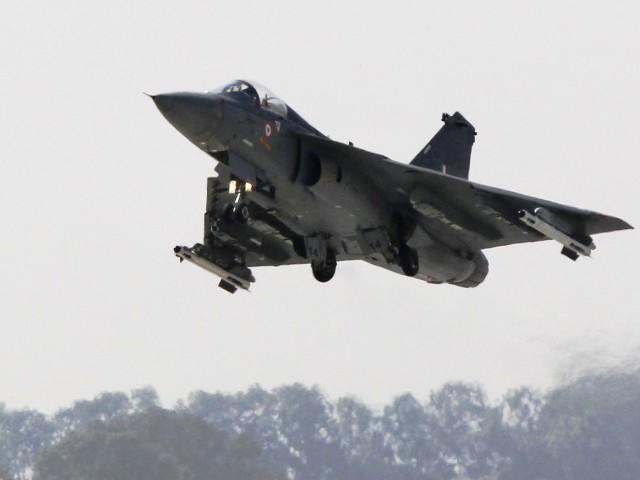
Today both LCA and JF-17 are reality and not on papers anymore. Tejas was inducted on 11 Jan, 2011 whereas JF-17 was inducted last year in Pakistani air force.
Both Indians and Pakistani have already started loving their new weapon, but in this new love they commit a mistake of comparing these two planes with each other. JF-17 will be Pakistan’s main fighter accompanied by their upgraded F-16s, whereas LCA Tejas will be India’s additional aircraft for medium role combat missions after Indo-Russian 5th generation fighter aircraft PAK-FA, Under-development indigenous 5th Gen AMCA (Advanced Medium Combat Aircraft), Indo Russian 4.5 Gen Su-30MKI and to-be-inducted 126 4.5 Gen MRCA Dassualt Rafael (Multi Role Combat Aircraft).
While Pakistan and China claim there aircraft as indigenous and result of 50-50 partnership between China and Pakistan, there are lot of foreign companies and organizations involved in making it a success.
After the U.S and European companies cancelled their participation in the development of the westernized Chengdu J-7 variant known as Super 7 which is openly based on MiG 21 design, China launched a program to develop an indigenous evolution of this Mig 21 based design. which was named as FC -1 (Fighter China 1)
To expedite its development, in 1998, China National Aero-Technology Import and Export Corporation (CATIC) purchased the abandoned Mikoyan MAPO Izd 33 design, research and test information and data along with other research and technical assistance which was developed under Project 33. This doesn’t mean that the design was now based on Mig 33 or that FC – 1 is the continuation of Soviet Project 33. The Project 33 started in 1980 and was stopped in 1986 taking the note of changing Soviet Union’s Air Force’s demands. Though later the improved version of the same design was introduced at the 1994 Farnborough Air Show as the briefly used marketing name for the MiG-29ME export model of the MiG-29M.
Although engineers from the Mikoyan Aero-Science Production Group (MASPG) have provided technical, research and design assistance on the FC-1 project, its aerodynamic design is quite different from that of Project 33. The wings are attached at mid-fuselage on the FC-1, whereas the Izd 33 is a low-wing design. The FC-1’s platform resembles that of the F-16, while that of the Izd 33 is similar to the MiG-29. The FC-1’s inlets are ‘D’-shaped and angled, but those for the Izd 33 are rectangular and slab-sided. Given the FC-1’s heritage of the ‘Super 7’, J-7, and MiG-21, some analysts believe that the FC-1’s internal structure is more likely based on the MiG-21 than on the Izd 33, which some have called a “single-engine MiG-29”.
Looking at the pictures one may say that the JF-17 Plane uses Soviet era’s MiG 21 airframe which is highly debatable. Although avionics and other basic things are superior in JF-17 than MiG 21.
In October 1995 Pakistan was asked to select a Western company before the end of the year which would provide and integrate the avionics in FC-1 for them (Source: http://www.flightglobal.com/articles/1995/10/18/21419/pakistan-nears-fc-1-avionics-decision.html).
Avionics suites were being proposed by FIAR and Thomson-CSF, based on the Grifo S7 and RC400 radars respectively (source: http://www.flightglobal.com/articles/1999/07/14/53912/china-and-pakistan-agree-on-super-7-fighter-development.html).
Russia’s Klimov offered a variant of the RD-33 turbofan engine to power the fighter. Russia earlier had denied China from transferring the engine to Pakistan as it was against Russian policy and India’s interest, but later, for some reason, Russia had no issue in China supplying those engines to Pakistan. To international media they replied in diplomatic parlance, Chinese were in such a hurry that they had not heard the last word from Russia on this subject. It is believed that Pakistan is unsatisfied with the engine and a new deal for a different engine, most probably to have Snecma M53-P2 could be finalized.
Rather than using the Ada programming language, which is developed dedicated for military applications, the software for the aircraft is written using the popular civilian C++ programming language which students use to develop programs in high schools, this might give an edge to Pakistan where software industry is not very skilled and C++ resources can be easily trained in large numbers (source: http://www.defenseindustrydaily.com/stuck-in-sichuan-pakistani-jf17-program-grounded-02984/).
In India’s LCA case: Airframe, Radar, Avionics, Cockpit, landing Gear, Ejection System, Flight Simulator, Software, Propulsion (when Kaveri will come) all are home made.
The pictures below are posted so people can compare JF 17 design with MiG 21 and MiG 29.
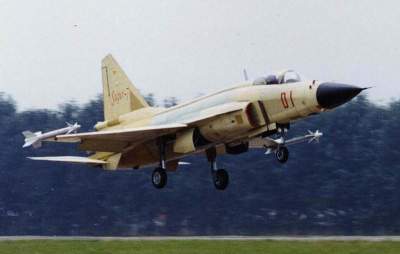 |
| JF-17 |
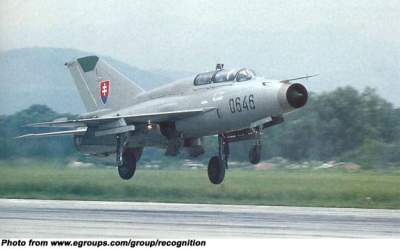 |
| MiG 21 |
 |
| MiG 29 |
Comparison According to 2008 Aviation Source Book, Aviation Week & Space Technology, January 28, 2008 and DRDO TechFocus February 2011″. DRDO. February 2011. Retrieved 9 April 2011.
Now among these two aircrafts it is very difficult to comment which one is better, as these aircrafts don’t belong to the same category. In terms of development, India’s LCA offers something new to the world, new design, new weapons, new systems and, in future, a new engine. While LCA was never made to be India’s Sukhoi but it does gives the platform to India for further modification and development of new projects Whereas Pakistan’s JF-17 is a modification of many previous technologies.
LCA program was started in 1983, whereas JF-17 program was started in 1989 as Chengdu F-7, which was later changed to Fighter China project in 1991. In 1995 Pakistan reportedly joined the project.
Though China has kept development and production of JF-17 on for delivering them to Pakistan and my be to other countries, it prefers J-10 fighters over JF-17 for its own airforce.
Both LCA and JF-17 are 4th generation fighter aircraft, but advanced composite frames and high tech electronics/avionics made international expert call LCA-Tejas a 4.5 Gen aircraft during Aero India 2010, in Bangalore.
While JF-17s are very much needed to serve depleting Pakistani Air Force as a main fighter along with F-16s, LCA is mainly a research project India has carried through these years. LCA was never made to compare with Sukhois, but it has faired very well on international level and now India has a platform and can develop more aircrafts on this platform as the plan of AMCA (Advanced Medium Combat Aircraft, an indigenous 5th gen stealth fighter) has already been cleared by the government.
While India has achieved self reliance in Air Fighter technology, Pakistan has achieved an experience of working in joint venture. It is the first major project of Pakistan with an international joint venture. India has previously worked with Russia in a partnership on development of world’s only supersonic cruise missile, Brahmos. Presently, India and Russia are also working on the development of 5th generation fighter aircraft PAK-FA, in a move to regain the air dominance which was taken over by the americans with their 5th gen F-22 which outsmarted Sukhoi 30 MKI, also a product of Indo-Russian partnership. India and France are also working on Surface to Air Missile “Maitri” project.
A Little bit of Fun and Sarcasm
“JF-17 Not as advanced as LCA: Nawaz Sharif, Former Prime Minister of Pakistan”(jpeg)
“I have heard it is very advanced plane, but it is not ready yet.” said Nawaz Sharif to retired Air Commodre Pervez Khokhar. Praising the JF-17 without mentioning Chinese cooperation, he further added in light mood, “I am saying you buy this plane from us, though it is not as advanced as your LCA, but it also has a glass cockpit like yours and can drop bombs for you,” he said in sarcastic mood.
Related Comparison Articles on The World Reporter



When most people picture a military armored vehicle, they immediately think of the Main Battle Tank, a key player in battlefields around the world. But the Main Battle Tank is not the primary mobile platform for servicemen and women. Instead, that is the Light Armored Vehicle: a military vehicle that’s speedier and more agile than a tank, while offering far greater levels of armored protection, firepower, and maneuverability than a civilian vehicle such as a 4×4.
In order to be fit for purpose, Light Armored Vehicles must measure up to rigorous measures, including STANAG 4569, an assessment that shows their ability to deal with kinetic energy, artillery, and IED attacks. But how exactly do modern Light Armored Vehicles protect themselves on the battlefield? Here are five of the key attributes shared by today’s most popular vehicles.
It’s all about the armor
A Light Armored Vehicle’s name suggests that, well, it’s lightly armored. In fact, that’s something of a misnomer. A Light Armored Vehicle may not be quite the heavy-duty bruiser that a Main Battle Tank is, but don’t make the mistake of thinking that a vehicle such as this doesn’t boast some impressive protection in case it’s hit during an attack. While its armor plating is not as formidable as a Main Battle Tank, the standard model LAV-25 (the Light Armored Vehicle most widely used by the U.S. Army and Marines, alongside other armies around the world) still boasts light gauge high hardness welded steel armor that offers effective protection against small arms rounds, without adding unnecessary weight.
Its impressive suspension system also promises improved survivability against IEDs. Some of the current models of LAVs have been in service since the 1980s. But there have been upgrades, such as the LAV-25 A2, which offers increased external and internal ballistic armor upgrades, including protection from fearsome 14.5 mm armor-piercing rounds. When the LAV-25 models are superseded sometime this decade, armor-driven survivability will be one of the big areas that will get an overhaul. New breakthroughs in materials science are opening up fresh avenues for exploration in armor that is lighter weight, but tougher than existing forms of armor plating currently in use.
Blast-resistant seating
The increased use of improvised explosive devices (IEDs) as part of asymmetric warfare is a trend that has transformed battlefields over the past two decades. To protect the lives of crew travelling in Light Armored Vehicles, along with other combat vehicles, special blast-attenuating seats have been installed. Some manufacturers produce potentially lifesaving seating options to fit all crew positions, including commander, gunner, driver and troop seats.
Smart sensors
Protection can mean armoring. It can also mean ways to avoid risking taking hits in the first place. Fortunately, smart sensors have come on a long way in recent years — and make this second option more viable than ever. Modern Light Armored Vehicles increasingly boast sensors designed to sense, classify, track, and defeat incoming threats. One example is their impressively sensitive radar and jamming technologies. These can be used to counter threats like drones by severing the link between the drone and its controller, causing them to crash out of the sky. This may be vital in scenarios where an attack may involve weaponry a Light Armored Vehicle would not be able to adequately defend against with its existing armor. Sensing the threat ahead of time means being able to take proactive steps to counter and avoid it.
The best defense is a good offense
Smart sensors are one proactive way for Light Armored Vehicles to protect themselves. Another is using offensive weapons. The LAV-25 boasts a two-person powered turret fitted with a 25 mm M242 “Bushmaster” chain gun. Internally, it features firing ports which can allow six fully-equipped infantrymen to defend the vehicle using personal weapons. There is additionally a 7.62mm machine gun in co-axial mounting for carrying out anti-infantry defense. If required, a second 7.62mm machine gun can also be mounted along the turret roof. Variations of the LAV-25 can be — and have been — fitted with anti-tank guided missiles, superior unmanned turret, mortars, 5-barreled Gatling cannons, Stinger missiles, smoke grenade dischargers, and more. Though Light Armored Vehicles are not intended to replace a Main Battle Tank, these vehicles can more than hold their own in the field of combat when required. And, as many a good strategist has noted, the best defense is a good offense.
Tires
Compared to the tracks used by Main Battle Tanks, Light Armored Vehicles far more closely resemble civilian 4x4s. But the rigors of travelling in warzones is very different to the requirements of driving on even the toughest of terrains in the civilian world. One of the key points of protection for a Light Armored Vehicle is its ability to easily traverse difficult terrain. That comes in handy when you’re avoiding threats such as IEDs which make travelling along ordinary roads prohibitive. Features such as Central Tire Inflation Systems (CTIS) help these military vehicles with better all-wheel drive performance and mobility. Many have a “limp home” feature that can allow them to carry out limited travel even in the event of major tire leaks. That avoids the risk inherent with a Light Armored Vehicle being rendered totally disabled on the battlefield.


The discovery of Stuxnet, a malware that targeted a nuclear facility, was somewhat revolutionary and groundbreaking. It targeted ICS which monitor and run industrial facilities. Before that, most of malicious programs were developed to steal information or break-in into financial sector to extort money. Stuxnet went beyond went and targeted high-level facilities. It is not hard to imagine what damage it could have inflicted if the worm were not detected. What is more worrisome, the technology is out. It might not be perfect, but it is definitely a start. Regardless of the intentions behind Stuxnet, a cyber bomb has exploded and everyone knows that cyber capabilities indeed can be developed and mastered.
Therefore, if they can be developed, they will probably be. The final goal of Stuxnet was to affect the physical equipment which was run by specific ICS. It was done in order to manipulate computer programs and make it act as an attacker intended it to act. Such a cyberattack had a particular motivation; sabotage of industrial equipment and destruction could have been one of the goals. So, if they were indeed the goals, it might have been an offensive act, conducted by an interested party, presumably, a state for its political objective. Yet, there are certain limitations when it comes to so-called “cyber weapons” (malware that might be employed for military use or intelligence gathering).
One of the main concerns of cyber offence is that code may spread uncontrollably to other systems. In terms of another physical weapon, it is like a ballistic missile that anytime can go off-course and inflict damage on unintended targets and/or kill civilians. Cyber offensive technology lacks precision, which is so valued in military. For example, in ICS and SCADA systems one may never know what can backfire because of the complexity of the system. The lack of precision consequently affects military decisions. When launching a weapon, officers should know its precise capabilities; otherwise, it is too risky and is not worth it.
In case of Stuxnet, the program started replicating itself and infected computers of many countries. For this moment we do not know if it were planned in that way. However, provided that that target was Natanz facility, it is unlikely. Symantec Corporation started analyzing the case only with external help; it did not come from Natanz. This exacerbates the case if a country decides to launch an offensive cyberattack.
If the military planning cannot prevent cyber technology to go awry or to go out in the public, it brings more disadvantages than advantages. Moreover, given a possibility of the code being discovered and broke down to pieces to understand what it does, it may potentially benefit an opposing party (and any other interested party along the way). This is unacceptable in military affairs.
Similarly, when the code is launched and it reaches the target, it can be discovered by an opponent. In comparison to nuclear, when a bomb explodes, it brings damage and destruction, but its technology remains in secret. In case of cyber, it may not be the case, as when a malware/virus is discovered, it can be reverse engineered to patch vulnerability. By studying the code, an enemy would find out the technology/tactics used that could be unfavourable in the long-run for the attacker.
Additionally, it should be said that not every malware is meant to spread by itself. In order to control the spread, vulnerability can be patched, meaning updating the software which had that vulnerability. An anti-malware can also be introduced; this will make the computer system immune to that particular vulnerability. Nonetheless, if the malware spreads uncontrollably, there is nothing much that an attacker can do. It is not possible to seize the attack. In this scenario, an attack may only release information about this certain vulnerability so that someone else can fix it. However, a state is highly unlikely to do so, especially if the damage is extensive. It would not only cost the state diplomatic consequences, but also it might severely impact its reputation.
An AI-enabled cyberattack could perhaps fulfill its potential. That means involvement of artificial intelligence. AI systems could make digital programs more precise, controlling the spread. In contrast, it could also lead to a greater collateral damage, if a system decides to target other facilities that may result in human death. Similar concerns are raised in the area of autonomous weapon systems in regard to the need of leaving decision-making to humans and not to technology. AI technology has a potential to make existing cyberattacks more effective and more efficient (Schaerf, 2018).
Aforementioned concern leads to another and affects the end result. When a certain weapon is employed, it is believed to achieve a certain goal, e.g. to destroy a building. With cyber capabilities, there is no such certainty. In the
Alternatively, the true costs of cyberattacks may be uncertain and hard to calculate. If that is so, an attacker faces high level of uncertainty, which may also prevent them from a malicious act (particularly, if nation states are involved). However, the costs and the benefits may always be miscalculated, and an attacker hoping for a better gain may lose much more in the end (e.g. consider Pearl Harbour).
Another concern refers to the code becoming available to the public. If it happens, it can be copied, re-used and/or improved. Similar concerns in regards to proliferation and further collateral damage emerged when Stuxnet code became available online. An attacker may launch a cyberattack, and if it is discovered, another hacker can reverse engineer the code and use it against another object. Moreover, the code can be copied, improved and specialized to meet the needs of another party. Technology is becoming more complex, and by discovering a malware developed by others, it also takes less time to produce a similar program and/or develop something stronger. (For instance, after Stuxnet, more advanced malwares were discovered – Duqu and Flame).
Furthermore, there are other difficulties with the employment of cyber offensive technology. In order to maximize its result, it should be supported by intelligence. In case of Stuxnet, an offender needed to pinpoint the location of the facility and the potential equipment involved. It has to find zero-days vulnerabilities that are extremely rare and hard to find[1]. Cyber vulnerability is all about data integrity. It should be reliable and accurate. Its security is essential in order to run an industrial infrastructure.
After pinpointing vulnerability, security specialists need to write a specific code, which is capable of bridging through an air-gapped system. In case of Stuxnet, all of abovementioned operations required a certain level of intelligence support and financial capability. These complex tasks involved into development were exactly the reason why Stuxnet was thought to be sponsored and/or initiated by a nation state. If intelligence is lacking, it may not bring a desirable effect. Moreover, if cyber offense is thought to be used in retaliation, malicious programs should be ready to use (as on “high-alert”) in the event of necessity.
Regardless of some
advantages of cyber offence (like low costs, anonymity etc), this technology
appears to be unlikely for a separate use by military. There is a high level of
uncertainty and this stops the army of using technology in offence. Truth is
when you have other highly precise weapons, it does not make sense to settle
for some unreliable technology that may or may not bring you a wanted result.
Yet, other types of
cyberattacks like DDoS attacks can give some clear advantages during military
operations and give an attacker some good cards in case of a conflict. When
such attacks used together with military ground operations, they are much more
likely to bring a desired result.
[1] For better understanding, out of twelve million pieces of malware that computer security companies find each year, less than a dozen uses a zero-day exploit.

As part of the program to replace its four Walrus-class submarines, the Dutch government is examining offers submitted by four European companies. It will announce by the end of the year which two competitors have been selected for the next negotiation stage.
Last June, Swedish Saab Kockums and Dutch partner Damen unveiled an initial design of submarine as part of their proposal to replace the Dutch Royal Navy’s fleet. During the European naval show in October, they further revealed technical details about their offer. Despite these announcements, Saab Kockums appears far from being able to draft more than drawings as it lacks the technology and manpower required to build submarines.
Kockums, a Swedish shipyard now known as Saab Kockums, made international headlines back in the 1990s when it closed a major deal with the Australian Navy to design their submarines fleet. Since then, the company seems to have become an empty shell.
In 2005, to strengthen its market position, Kockums joined its German competitor TKMS. Their partnership soon deteriorated as Kockums failed to attract new clients and retain old ones. The A26-class Kockums was developing did not sell well on the international market. Designed in the early 1990s, this sub class was considered outdated and too pricy. In 2013, after 20 years of cooperation, Kockums lost a contract with Singapore. Although TKMS eventually managed to win that contract thanks to another subsidiary, it led to increased tensions between the two companies.
In 2014, Russia’s realpolitik and the Ukrainian crisis led the Swedish government to reconsider its naval capabilities. The government realized the capacity to build submarines was of strategic importance, calling for Swedish companies to maintain an adequate level of competency. The Parliament decided to renew its subs fleet and promote local skills by ordering two updated ersatz of the A26-class to Kockums. However, the Swedish government failed to agree on the price with TKMS, ending the negotiation. At the height of the crisis, Swedish military authorities stormed Kockums’ laboratory in Sweden to retrieve technology that, according to them, belonged to the army. After that incident, deemed unusual by military experts, TKMS entered talks with Saab to sell Kockums. The sale was eventually closed later that year.
Over the past decades, U-boots have evolved from a fighting device to a diplomatic, sovereignty and intelligence tool. It is now used to locate enemies, deploy elite troops, collect data and send political messages. They require cutting-edge technology and constant research and development. Of all naval solutions, designing subs poses the greatest technical challenges and hence require special skillsets. Not keeping up with the fast-changing evolutions can quickly become the death knell of subs’ designers. Though Kockums prove to be a competitive submarine maker in the 1990s, not constructing subs over the last two decades means they have lost their technical and technological expertise. The price at which the company was sold is quite revealing. First thought to be worth 1 billion kronor, Kockums was sold for 340 million kronor (US$ 50,4 million).
The Dutch Navy is internationally recognized for the role its subs played in reducing piracy in the Gulf of Aden. It is part of the few countries able to furtively navigate oceans. The construction of its new submarine fleet is scheduled to start in 2021 and be operational by 2027. Saab Kockums is offering its updated A26-class and it might not be able to meet the deadlines. The A26-class has never been built before and, even if its design has been updated, the scope of the technical adjustments needed for this class to function smoothly is not yet known. With the technology used in naval solutions rapidly evolving, it might as well be less time-consuming to develop an entirely new class rather than update an ancient model.
Moreover, there are doubts about Saab Kockums’ capacity to continue its activities in a few years from now. The company already inked several deals with the Swedish Navy. However, to be able to keep up with the investments needed in research and development, Saab Kockums must succeed on export markets. If it fails to secure multiple deals abroad, it will eventually go bankrupt. With such scenario, betting on them might not be the smartest move.
The future does not look bright for Saab Kockums. Though signing with the Dutch Navy could temporarily be good news for them, without sustainable investments in research it will go down like a lead zeppelin!